 All orders Built, Shipped & Supported from within the European Union
All orders Built, Shipped & Supported from within the European Union
All orders Built, Shipped & Supported from within the European Union
Open, Scalable Storage for File, Block and Object Data
Broadberry Ceph storage combines open source software with hardware designed around your workloads, performance, capacity and resilience requirements.
From shared file storage and virtual infrastructure to object repositories and AI data lakes, Broadberry designs, integrates and validates the complete Ceph environment.
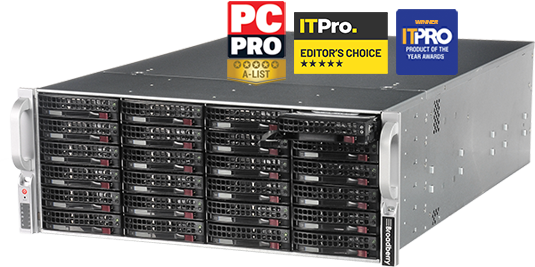
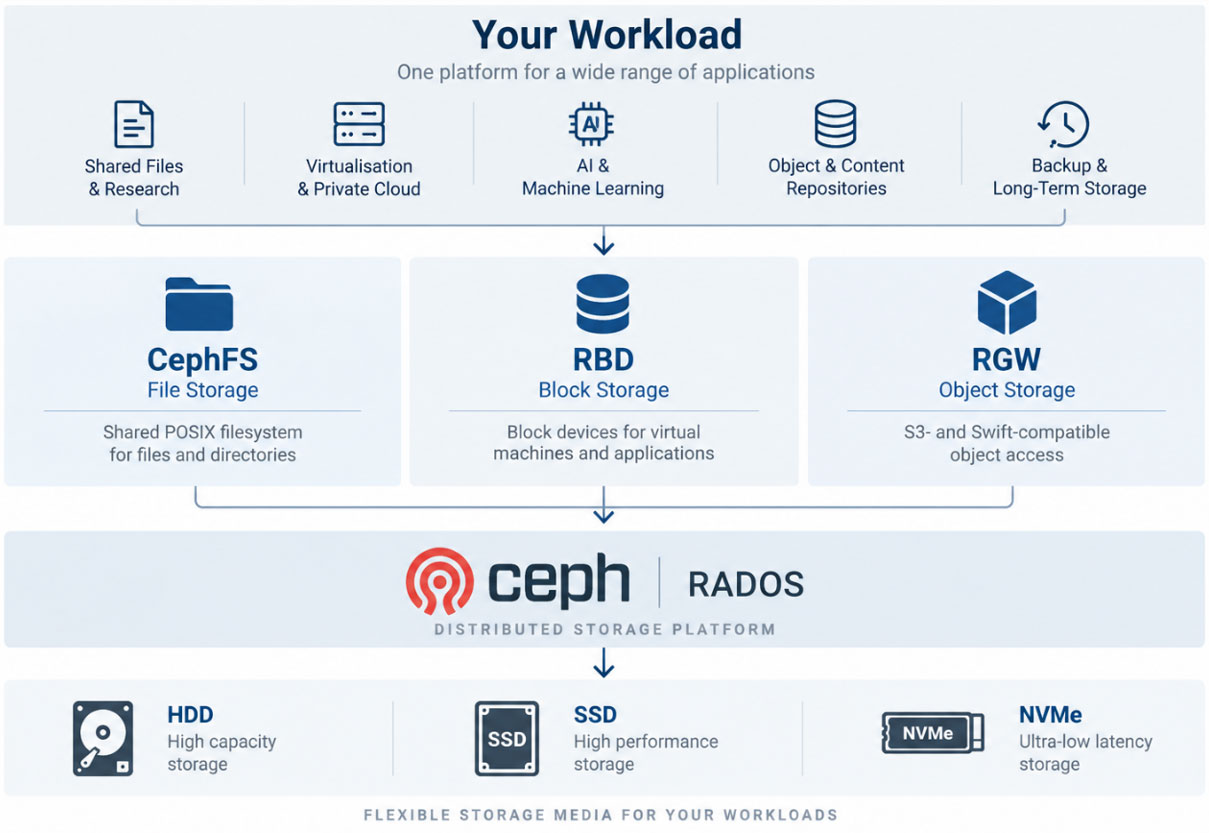
Ceph provides a common distributed storage foundation while allowing applications to access data through the interface they require.
| CephFS | RBD | RGW |
| File Storage | Block Storage | Object Storage |
| Shared POSIX filesystem for files and directories | Block devices for virtual machine and applications | S3- and Swift-compatible object access |
| Ideal for: Shared files, research, AI datasets | Ideal for: Virtualisation, private cloud | Ideal for: Object repositories, cloud-native applications |
These are separate access models. Data stored through one service does not automatically appear through another.
Before recommending a Ceph architecture, Broadberry evaluates your workloads, application services, capacity, performance and resilience requirements.
Define applications, I/O,
latency, throughput and
concurrency.
Calculate usable capacity,
protection overhead,
reserve and growth.
Select CephFS, RBD and
RGW services around
application requirements.
Engineer compute, memory,
storage media, networking
and failure domains.
Test performance, recovery
and application compatibility
before deployment.
Plan monitoring, upgrades,
expansion and ongoing
cluster health.
Ceph can support very different storage requirements. The application determines the service, media and architecture.
| Workload | Ceph Service | Design Priority |
| Shared Files & Research | CephFS | Metadata performance and concurrent access |
| Virtualisation & Private Cloud | RBD | Random I/O latency and recovery |
| Object & Content Repositories | RGW | Gateway scale and usable capacity |
| Backup & Long-Term Storage | CephFS / RGW | Ingest, restore and retention |
| AI Data Lakes & Training | CephFS | Throughput, metadata and active-data performance |
Ceph lets Broadberry tailor storage media, data protection and infrastructure to different workload requirements.

Combine HDD capacity with SSD or NVMe performance pools.

Protect data across drives, hosts and racks using defined failure domains.

Add OSD nodes as capacity and workload requirements grow.

Deploy Ceph on standard, non-proprietary server infrastructure.
Usable capacity depends on protection, failure domains and recovery requirements. Broadberry designs Ceph storage to deliver the capacity your applications can actually use.
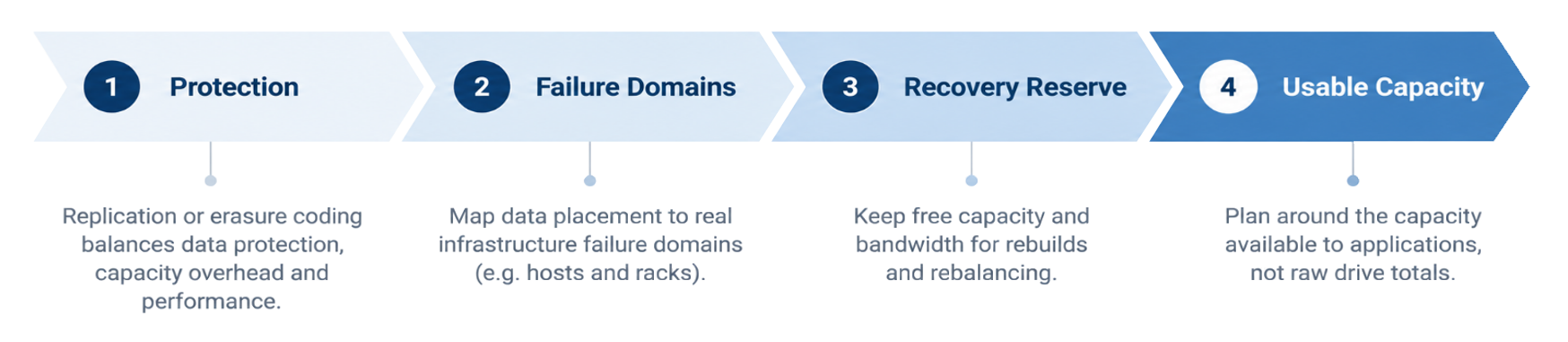
Ceph supports a wide range of workloads across file, block and object storage.
| Use Case | Typical Requirements |
| Virtualisation & Private Cloud | Shared block storage for VMs and cloud infrastructure |
| Shared Files & Research | Common file access for research data and collaborative workflows |
| AI & Machine Learning | Shared access to training datasets and active AI data |
| Object & Content Storage | S3-compatible storage for applications and large repositories |
| Backup & Long-Term Storage | Scalable capacity for backup, retention and recovery |
| Containerised Workflows | Persistent shared storage for distributed applications |
Broadberry combines Ceph expertise with workload-led hardware design to deliver a complete, validated storage platform rather than simply supplying the servers.

Designed around your applications, performance and capacity needs.

Compute, memory, media, networking and Ceph services designed together.

Choose HDD, SSD and NVMe configurations.

Support from planning through future expansion.
What is the difference between Ceph and CephFS?
Ceph is the distributed storage platform. CephFS is its shared filesystem. Ceph can also provide block storage through RBD and object storage through RGW.
Can Ceph support virtual machines?
Yes. RBD provides block devices through supported host and hypervisor integrations. The configuration should be sized and validated for the expected VM workload and recovery requirements.
Can Ceph use both HDD and NVMe storage?
Yes. Different media classes and placement rules can be used to create capacity and performance pools. Adding NVMe, however, does not automatically accelerate all data in the cluster.
Is Ceph suitable for AI and GPU clusters?
Yes, when the storage media, metadata services and networking are designed to meet the application's performance requirements. CephFS can provide shared file access across GPU hosts, while flash pools can be used for active training data.
Should every Ceph pool use erasure coding?
No. Replication and erasure coding have different capacity, performance and recovery trade-offs. CephFS metadata pools require replication, while appropriate data pools may use erasure coding.
Does Ceph eliminate the need for backup?
No. Distributed redundancy and snapshots protect against different risks than an independent backup. Backup, retention and off-site recovery should be planned separately.
Can Ceph scale as storage requirements grow?
Yes. Additional OSD nodes can add capacity and resources, but expansion triggers data placement changes and rebalancing. Broadberry plans capacity reserve, networking and recovery requirements as part of the architecture.
Tell us about your applications, capacity, performance and recovery requirements. Broadberry will design a Ceph storage architecture around the services, media and protection policies your environment needs.

 Our Rigorous Testing
Before leaving our UK workshop, all Broadberry server and storage solutions undergo a rigorous 48 hour testing procedure. This, along with the high-quality industry leading components ensures all of our server and storage solutions meet the strictest quality guidelines demanded from us.
 Un-Equaled Flexibility
Our main objective is to offer great value, high-quality server and storage solutions, we understand that every company has different requirements and as such are able to offer un-equaled flexibility in designing custom server and storage solutions to meet our clients' needs.
We have established ourselves as one of the biggest storage providers in the UK, and since 1989 supplied our server and storage solutions to the world's biggest brands. Our customers include:

CyberServe EPYC EP1-102A
A powerful AMD EPYC rack server for small spaces...
| August 26, 2026
CyberServe Ryzen RY1-104A
A core-heavy Ryzen rack server at an entry-level price ...
| April 01, 2024
CyberServe Xeon SP1-102G NVMe G5
A small, powerful, and affordable rack server.
Broadberry gets edgy with a great value rack server...
| December 01, 2023
Intel M50CYP2UR208 Coyote Pass Server - 8 Drive Bays. SAS/SATA/NVME
A mighty server package for the price with a big helping of blisteringly fast Intel Optane 200 PMEMs...
| August 02, 2021
Call Our EU Sales Team Now| German / English: | +49 89 1208 5600 |
| French / English: | +33 1 72 81 06 78 |
